| Internal | Description |
| Yolk | The yolk or yellow portion makes up about 33% of the liquid weight of the egg. It contains all of the fat in the egg and little less than half of the protein. With the exception of riboflavin and niacin, the yolk contains a higher proportion of the egg’s vitamins than the white. All of the egg’s vitamins A, D and E are in the yolk. Egg yolks are one of the few foods naturally containing vitamin D. The yolk also contains more phosphorous, manganese, iron, iodine, copper and calcium than the white, and it contains all of the zinc, The yolk of a Large egg contains about 59 calories. Double yolked eggs are often produced by young hens whose egg production cycles are not yet completely synchronised. They’re often produced, too, by hens who are old enough to produce ExtraLarge eggs, Genetics is a factor, also. Occasionally a hen will produce double yolked eggs throughout her egg laying career. It is rare, but not unusual, for a young hen to produce an egg with no yolk at all. Sometimes there is a greenish ring around hard-cooked eggs yolks. It is the result of sulphur and iron compounds in the egg reacting at the surface of the yolk. Occasionally several concentric green rings may be seen in hard-cooked egg yolks. A yolk develops within the hen in rings. Iron in the hen’s feed or water as the rings are formed may cause this colouring. The yolk colour depends on the diet of the hen, but should be rich bright golden yellow, free from blood streaks or spots. Well rounded smooth on surface, and well raised from the albumen. One uniform shade. Blastoderm or germ spot should not be discoloured. |
| Albumen | Also known as egg white. Albumen accounts for most of an egg’s liquid weight, about 67%. It contains more than half the egg’s total protein, niacin, riboflavin, chlorine, magnesium, potassium, sodium and sulphur. The albumen consists of four alternating layers of thick and thin consistencies. From the yolk outward, they are designated as the inner thick or chalaziferous white, the inner thin white the outer thick white and the outer thin white. Egg white tends to thin out as an egg ages because its protein changes character. That is why fresh eggs sit up tall and firm in the pan while older ones tend to spread out. Albumen is more opalescent than truly white. The cloudy appearance comes from carbon dioxide. As the egg ages, carbon dioxide escapes, so the albumen of older eggs is more transparent than that of fresher eggs. Preferably white in colour, of dense substance, particularly around the yolk, which it raises. Outline of albumen to be seen. Free of blood spots |
| Chalazae | Each chalazae to resemble a thick cord of white albumen at each end of the yolk, keeping it in the centre of the first or thickest albumen (white). Free of blood spots. Other layers of albumen less dense. |
| Germinal Disc | The entrance of the latebra, the channel leading to the centre of the yolk. The Germinal disc is barely noticeable as a slight depression on the surface of the yolk. When the egg is fertilised, sperm enter by way of the germinal disc, travel to the centre and a chick embryo starts to form. |
| Airspace | The empty space between the white and shell at the large end of the egg. When the egg is first laid, it is warm. As it cools, the contents contract and the inner shell membrane separates from the outer shell membrane to form the air cell. As the egg ages, moisture and carbon dioxide leave through the pores of the shell, air enters to replace them and the air cell becomes larger. Although the air cell usually forms in the large end of the egg, it occasionally moves freely toward the uppermost point of the egg as the egg is rotated. It is the called a free floating air cell. If the main air cell ruptures, resulting in one or more small separate air bubbles floating beneath the main air cell, it is known a bubbly air cell. For exhibiting purposes the air space should be very small, as befits a new-laid egg, the membrane still adhering to shell. |
| Blood Spots | Also called meat spots. Occasionally found on an egg yolk. Contrary to popular opinion, these tiny spots do not indicate a fertilised egg. Rather, they are caused by the rupture of a blood vessel on the yolk surface during formation of the egg or by a similar accident in the wall of the oviduct. Less of 1% of all eggs produced have blood spots. As an egg ages, the yolk takes up water from the albumen to dilute the blood spots so, in actuality, a blood spot indicates that the egg is fresh. |
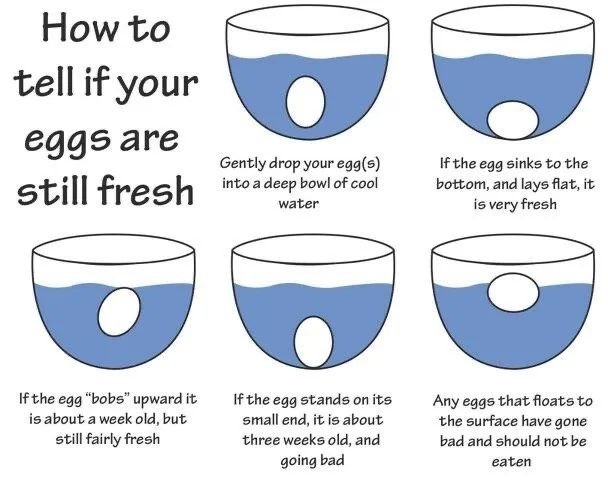
| Freshness | Indicated by small airspace, and unwrinkled top surface of yolk, and its height. Stale yolks flop at edges and as an egg ages the white becomes more runny. |