
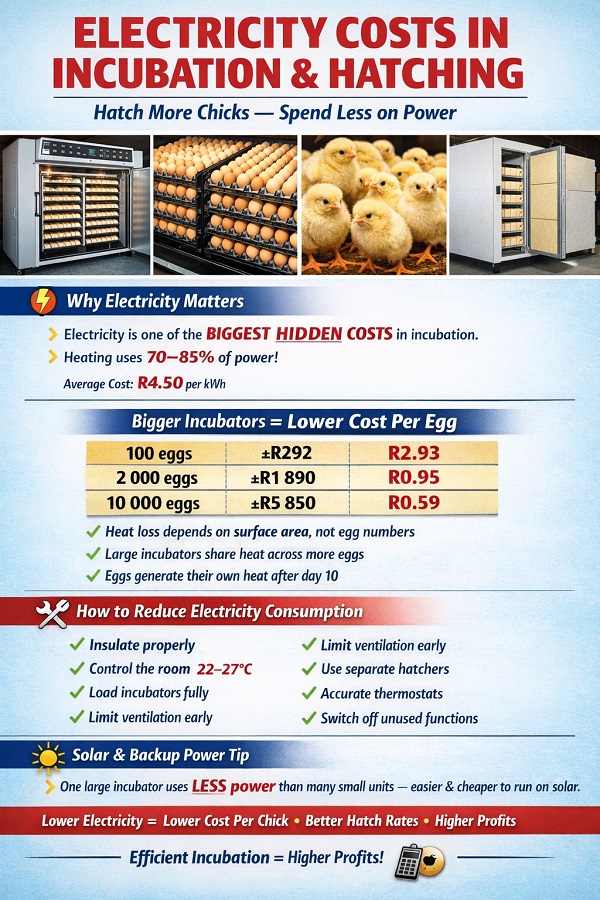
How to Reduce Power Use and Lower Your Cost per Chick
Electricity is one of the most overlooked costs in incubation and hatching. While feed and chicks get most of the attention, poor incubator efficiency can quietly eat into profits month after month. Understanding how electricity is used—and how to reduce it—can significantly improve hatchery margins, especially as incubator size increases.
Let’s break it down.
Where Electricity Is Used in Incubation
An incubator consumes electricity mainly for:
- Heating elements – maintaining 37.5 °C during incubation and ±36.8–37.2 °C during hatching
- Fans – air circulation and temperature uniformity
- Turning motors – egg turning during the first 18 days
- Humidity systems – heaters, pumps, or ultrasonic humidifiers
- Control electronics – thermostats, sensors, displays, alarms
Among these, heating accounts for 70–85% of total power usage.
Typical Electricity Consumption
Below is a rough but realistic guideline for modern incubators:
| Incubator Size | Eggs | Average Power Draw | 21-Day Energy Use |
|---|---|---|---|
| Small tabletop | 100 | 120–150 W | ±65 kWh |
| Medium cabinet | 500 | 300–400 W | ±170 kWh |
| Large cabinet | 2 000 | 800–1 000 W | ±420 kWh |
| Commercial unit | 10 000 | 2.5–3.0 kW | ±1 300 kWh |
Using an average electricity cost of R4.50 per kWh, the cost becomes clearer.
Why Bigger Incubators Have Lower Cost per Egg
This is where many small operators lose money without realizing it.
Example 1: 100-Egg Incubator
- Energy use: 65 kWh
- Cost: 65 × R4.50 = R292.50
- Cost per egg: R2.93 per egg
Example 2: 2 000-Egg Incubator
- Energy use: 420 kWh
- Cost: 420 × R4.50 = R1 890
- Cost per egg: R0.95 per egg
Example 3: 10 000-Egg Incubator
- Energy use: 1 300 kWh
- Cost: 1 300 × R4.50 = R5 850
- Cost per egg: R0.59 per egg
Why this happens
- Heat loss depends on surface area, not egg count
- Larger incubators share the same heat across thousands of eggs
- Fans and controllers scale slowly compared to egg capacity
- Eggs themselves generate metabolic heat after day 10
Result: Bigger incubators are far more energy-efficient per egg.
Practical Ways to Reduce Electricity Consumption
1. Improve Insulation (Biggest Impact)
- Use 50–75 mm polyurethane or polystyrene insulation
- Seal all doors, joints, and cable entry points
- Avoid metal walls without insulation
💡 Poor insulation can double electricity usage.
2. Control the Room, Not Just the Incubator
- Keep incubator room between 22–27 °C
- Avoid cold floors and draughts
- Shade roofs and walls from direct sun
Every 1 °C drop in room temperature increases heater runtime.
3. Use Correct Ventilation Timing
- Don’t over-ventilate early in incubation
- Excess fresh air = lost heat
- Increase ventilation gradually after day 10 when embryos generate heat
4. Avoid Under-Loading Incubators
Running a 2 000-egg incubator with 400 eggs is extremely inefficient.
Rule:
👉 Either fill the incubator or use a smaller one.
5. Separate Incubators and Hatchers
- Hatchers run cooler and wetter
- Opening incubators during hatch causes massive heat loss
- Dedicated hatchers reduce heater cycling and fan load
6. Use Accurate Sensors
- Cheap thermostats overshoot and undershoot
- Temperature swings cause heaters to cycle excessively
- Stable control = lower electricity use
7. Turn Off What You Don’t Need
- Disable egg turning after day 18
- Reduce unnecessary lighting and displays
- Avoid opening doors unless necessary
Solar and Backup Power Considerations
If running on solar or inverter systems:
- Incubators prefer stable continuous power
- Heating spikes occur at night and during cold weather
- Larger incubators are easier to power efficiently than many small units
Key Takeaways
- Electricity cost per egg drops sharply as incubator size increases
- Heating efficiency and insulation matter more than brand names
- Running half-empty incubators is one of the biggest hidden losses
- At R4.50/kWh, energy efficiency directly impacts profitability
A well-designed, well-loaded incubator doesn’t just hatch better—it costs less to run per chick, making larger, efficient systems the smarter long-term investment.